Hedgehog Class
Class teacher’s welcome
Welcome to Hedgehog class! This year promises to be an exciting journey of learning and discovery, expanding the children’s knowledge and curiosity into years 2 and 3. Throughout the year, we will help the children to grow and develop socially and academically, build their independence and continue to foster their love of learning.
Please could I say a huge Thank you to everyone who came to our Collective Worship and stayed for our Art lesson. The art works created were an amazing showcase.
Mrs Simmonds
** Reminder** Sports Week! WC 15th June
- Year 2 Sports Day- Tuesday 16th June – 1- 3pm
- Year3 Sports day – Wednesday 17th June – 9-12pm


Curriculum news
Summer 1:
The “At a Glance” overview, which was previously updated on the website each half term, is now provided as an attached newsletter document for ease of access.
Spellings and Phonics
At All Saints’ Primary School, we follow Little Wandle Phonics which then transfers into the Read, Write Inc. spelling scheme in Key Stage 2. You can find an overview of your child’s spellings below.
Year 2s will be focusing on the following during their sessions this half term:
Phase 5 review:
| Week 1 | /ai/ a-e ai ay a eigh ea ey aigh /ee/ y ea ee e ie ey e-e /igh/ igh i-e i y ie /oa/ ow o o-e oa oe ou | people eye
whole |
| Week 2 | oo/ /yoo/ oo u u-e ew ue ou ui /air/ air are ear ere /ur/ er ur ir or ear /ow/ ou ow | through improve move prove shoe two who beautiful their parents |
| Week 3 | or/ or a aw au ore oor al oar our augh aur /zh/ si su /ch/ ch tch ture* /sh/ sh ti ch ssi ci si | thought sure |
| Week 4 | j/ j g ge dge /s/ s ss c ce se st sc /u/ ou /e/ ea /i/ y /o/ a /u/ o o-e /oo/ u oul schwa: er a or ar our re | once again any many friend busy pretty because laugh** |
| Week 5 | ie /ee/ /igh/ y /ee/ /igh/ /i/ ea /ee/ /e/ /ai/ a /a/ /ai/ /or/ | friend |
Autumn 2:
| Week 1 | What do I need to know to think about spelling? How do I use the Complete the code chart to help me to spell? | Homophones and near-homophones |
| Week 2 | Why do I double letters at the end of words? Why do I double letters in some longer words ending in -er? | Adding -ing, -ed, -er, -est and -y to words of one syllable ending in a single consonant letter after a single vowel letter |
| Week 3 | Why do some words end in ‘k’ or ‘ck’? Why do some words end in ‘ch’ or ‘tch’? | |
| Week 4 | When do I add the suffix -es/-s to words? Why do I double the final letter in some words when I add the suffix -ing? | Adding -ing, -ed, -er, -est and -y to words of one syllable ending in a single consonant letter after a single vowel letter |
| Week 5 | Why do I swap the ‘y’ for an ‘i’ when I add the suffix -ed? Why do I drop the ‘e’ when I add the suffix -ing? | Adding -ed, -ing, -er and -est to a root word ending in -y with a consonant before it Adding the endings -ing, -ed, -er, -est and -y to words ending in -e with a consonant before it |
Spring:
| Week | Focus | Example Words |
| Week 1 | The or sound spelt a before l and ll. | almost, already, chalk, small, stalk, talk, altogether, Red Words: above, after, again |
| Week 2 | Soft c . | Circus, city, concert, excellent, exercise, fancy, notice, pencil, Red Words: any, anyone, are |
| Week 3 | Adding the suffix –y (1) | Dotty, muddy, spotty, runny, sunny, yummy, foggy, funny Red Words: ask, bath, beautiful |
| Week 4 | Special focus 1: Red words. Common exception
Special Focus 2: Homophones. |
1: where, could, there, want, was, would, what
2: See/sea, son/sun, blew/blue, knight/night, saw/sore |
| Week 5 | Adding the suffix –y (2) | Breezy, crazy, curvy, greasy, simply, spiky, wheezy, Red Words: behind, both, bought |
| Week 6 | Adding the suffix –ly | Bravely, foolishly, happily, loudly, nearly, softly, warmly Red Words: break, brother, buy |
| Week 7 | Half term | |
| Week 1 | The n sound spelt kn and gn. | Gnash, gnaw, gnome, knead, knee, knock, knit, Red Words: caught, child, children |
| Week 2 | The igh sound spelt y. | Butterfly, horrify, July, multiply, my, nearby, reply, Red Words: Christmas, class, climb |
| Week 3 | Adding the suffix –ing (1) | Beginning, clapping, dropping, gripping, nodding, shopping, tripping Red Words: clothes, cold, come |
| Week 4 | Special focus 3: Red words. Common exception
Special Focus 4: Homophones. |
3: money, people, busy, half
4: There/their, no/know, right/write, to/too, week/weak |
| Week 5 | Adding the suffix –ing (2) | Baking, cracking, phoning, racing, shading, tickling, writing, Red Words: does, door, down |
| Week 6 | Half term |
Year 3s:
| Week | Focus | Example Words |
| 8 Sep | The or sound spelt a before l and ll. | almost, already, chalk, small, stalk, talk, altogether, Red Words: above, after, again |
| 15 Sep | Soft c . | Circus, city, concert, excellent, exercise, fancy, notice, pencil, Red Words: any, anyone, are |
| 22 Sep | Adding the suffix –y (1) | Dotty, muddy, spotty, runny, sunny, yummy, foggy, funny Red Words: ask, bath, beautiful |
| 29 Sep | Special focus 1: Red words. Common exception
Special Focus 2: Homophones. |
1: where, could, there, want, was, would, what
2: See/sea, son/sun, blew/blue, knight/night, saw/sore |
| 6 Oct | Adding the suffix –y (2) | Breezy, crazy, curvy, greasy, simply, spiky, wheezy, Red Words: behind, both, bought |
| 13 Oct | Adding the suffix –ly | Bravely, foolishly, happily, loudly, nearly, softly, warmly Red Words: break, brother, buy |
| 20 Oct | The n sound spelt kn and gn. | Gnash, gnaw, gnome, knead, knee, knock, knit, Red Words: caught, child, children |
| 28 Oct | – HALF TERM | – |
| 3 Nov | The igh sound spelt y. | Butterfly, horrify, July, multiply, my, nearby, reply, Red Words: Christmas, class, climb |
| 10 Nov | Adding the suffix –ing (1) | Beginning, clapping, dropping, gripping, nodding, shopping, tripping Red Words: clothes, cold, come |
| 17Nov | Special focus 3: Red words. Common exception
Special Focus 4: Homophones. |
3: money, people, busy, half
4: There/their, no/know, right/write, to/too, week/weak |
| 24 Nov | Adding the suffix –ing (2) | Baking, cracking, phoning, racing, shading, tickling, writing, Red Words: does, door, down |
| 1 Dec | The j sound. | Adjust, bridge, charge, energy, gentle, large, urgent, Red Words: even, every, everybody |
| 8 Dec | The o sound spelt a after w and qu. | Quality, quantity, squash, wallet, wander, wasp, watch, Red Words: eye, fast, father |
| 15 Dec | Special focus 5: Contractions and apostrophes. | 5: I’m, I’ll, |
Spring:
| Week | Focus | Example Words |
| 12th Jan | Adding the suffix –ed (1) | Dropped, hugged, chipped, clapped, stepped, flipped, spotted, Red Words: fast, Father, find |
| 19th Jan | Adding the suffix –ed (2) (swapping y for i). | Carried, fried, hurried, married, multiplied, tried, replied
Red Words: gold, grass, great |
| 26th Jan | Adding the suffix –ed (3) (dropping e to add –ed, and revision of doubling final consonant and swapping y for i). |
Battled, cycled, denied, liked, ruled, phoned, striped, Red Words: half, has, here |
| 2nd Feb | The u sound spelt o, and the or sound spelt ar after w. | brother, other, nothing, Monday, swarm, reward, warm Red Words: hold, hour, house |
| 9th Feb | Possessive apostrophes. | Practice Red words from this half term so far. |
| 16th Feb | The r sound spelt wr | wrong, wrestle, wrist, wrap, write |
| 23rd Feb | The r sound spelt wr | wreck, wrinkle, wriggle, wren |
| 2nd March | Adding the suffixes -er or -est (1) | faster, slowest, louder, largest, braver
|
| 9th March | Special Focus 1 (Red words) and Special Focus 2 (Homophones) | 1: many, some, should, come, any, would
2: there/their, nose/knows, for/four |
| 16th March | Adding the suffixes -er or -est (2) | happier, silliest, funnier, finest, wiser, nicest, slimier, trickiest |
| 23rd March | Adding the suffixes -er or -est (3) | bigger, slimmest, hotter, saddest, wetter, fittest, maddest |
| 30th March | Half-term | |
| 6th April | ||
| The ee sound spelt ey | key, donkey, chimney, turkey, trolley, money, honey, jockey | |
| Adding the suffix -ness (1) | Kindness, sadness, illness, weakness, darkness, foolishness | |
| Adding the suffix -ness (2) | dizziness, silliness, cheekiness, madness | |
| Words ending in -le | rattle, simple, middle, triangle, giggle, bubble, handle, battle, little, table | |
| Special Focus 3 (Words ending -il and words where s makes the zh sound ) and Special Focus 4 (Homophones) | 3: fossil, council, evil, peril, nostril; measure, treasure, usual, television
4: seen/scene, wait/weight, hole/whole, sighed/side, new/knew |
|
| Words ending in -el | camel, tunnel, towel, travel, jewel, label, angel, cancel, level | |
| Words ending in -al | magical, plural, vocal, tropical, animal, capital, medical, signal, festival | |
| Adding the suffix -ful | joyful, cheerful, thankful, wonderful, hopeful, painful, colourful, thoughtful | |
| Special focus 5 (ir sound spelt or after w) | 5: worm, world, work, worth, worst, password, workshop | |
Home Projects:
Home Learning Projects – Summer Term
Geography & Science Projects
Create a Volcano Model
Build your own volcano using recycled materials.
- Label parts such as crater, lava and magma
- Optional: create a simple eruption!
Earth Layers Diagram
Design a colourful poster showing the layers of the Earth:
- Crust
- Mantle
- Outer core
- Inner core
Rock Detective
Go on a mini rock hunt!
- Collect 3–5 rocks
- Compare how they look and feel (smooth, rough, hard)
- Draw or write your observations
Earthquake Challenge
Build a small tower using Lego or household items.
- Test it by gently shaking the surface
- Can you make it stronger?
English Projects
Write a Mini Fable
Create a short story with:
- Animal characters
- A clear moral or lesson
Volcano or Mountain Poem
Write a free verse poem inspired by nature.
- Use powerful describing words
- Think about how it looks, sounds and feels
Create a Legend
Invent your own legend explaining:
- How a mountain formed
- Or why a volcano erupts
Creative Projects
Textured Artwork
Create an art piece using different materials (e.g. sand, paper, paint).
- Focus on textures: rough, smooth, bumpy
Make a Fossil
Use clay or salt dough to create a fossil.
- Press objects like leaves or shells into it
Please bring your home project during the week beginning the 16th March . The suggested projects are just ideas. You are welcome to create anything you like based on what we’ve learned this term.
Dates for the diary
PE days: Tuesday (Mrs Whike), Wednesday (Mrs Simmonds),
Links to support learning
Reading
Please encourage your child to read daily for a minimum of 10 minutes. At least 3 reading sessions per week should be recorded in the school Reading Record. Children should all have a school reading book (that can be changed regularly) but should be encouraged to read other material as well.
Maths
Year 2 Numbots (login on inside front cover of Reading Record) – Children work through the different levels to help secure their calculation skills and number facts.
Year 3 Times Table Rock Stars (login on inside front cover of Reading Record) – Y3 introduces 3, 4 and 8 multiplication tables, as well as building on 2, 5 and 10 (from Y2)
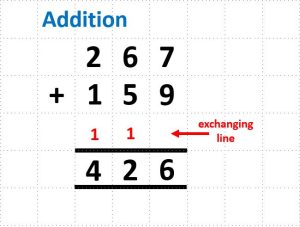
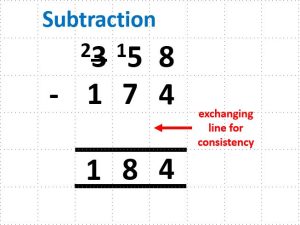
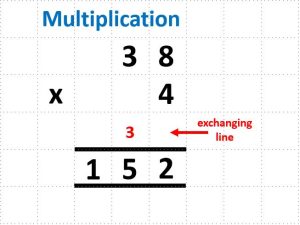
Written methods for addition, subtraction and multiplication are taught as in the pictures below.